
"Something Is Different About Growing Up Today"
It's not a parenting failure. It's not your teenager's fault. It's a cultural shift — and a generation is paying the price.
The (dis)Connection Crisis Affecting This Generation.
A study from Harvard on health and wellbeing found that close, meaningful relationships are the single most powerful predictor of joy–far outweighing wealth, status, or achievement. (Harvard Study of Adult Development)
Something is systematically pulling young people away from those relationships.
For most of human history, young people learned how to connect the same way — pickup games after school, long phone calls, hours of unstructured time with friends. These weren't just fun — they were the training ground for empathy, communication, and connection. Nobody scheduled it. Nobody taught it. Without knowing it youth were practicing connection.
That practice is disappearing. Screen time has replaced face-to-face time. AI companions are replacing real friendships. And connection — like any skill — doesn't develop without practice.
This isn't a generation that doesn't care. It's a generation that hasn't had enough practice.

Young People are struggling with connection
It’s Not Screens. It’s Disconnection.
Parents often blame the phone. But the phone is a symptom, not the cause. Since 2009, the average teen's face-to-face social time has dropped dramatically — replaced by passive scrolling, group chats, and increasingly, AI-powered companions designed to simulate friendship rather than build it. Connection is a skill. And like any skill, it can be learned, strengthened, and built — at any age.
A note for parents about AI companions
The question to ask isn't "is my child using AI?" — it's "does this use of AI help them connect better with real people, or does it get in the way?"
→ Read our full guide: “AI Friends & Your Child"
Therapy Helps. But when kids either don’t need, or don’t want therapy they need practice.
Most parents try the obvious paths. A tutor for the grades. A therapist for the anxiety. Extra sports for the confidence. These are valuable — but they often miss the core issue. When a young person is struggling socially, the typical response is: do nothing and hope it passes, or refer them to therapy. But most teens aren't in crisis — they're in a gap. WeYouth exists in that gap. Not therapy. Not tutoring. Connection coaching — a skill-building approach designed specifically for young people.
To address this gap, WeYouth spent over four years in collaboration with youth clinicians, educators, and scientists to develop a groundbreaking new resource: Connection Coaching. Two skilled coaches — one experienced, one near-peer — lead personalized sessions helping young people strengthen the relationships that matter most.
Sessions are 45–50 minutes, weekly, for 1–3 months. No diagnosis required. No crisis needed. Just a young person ready to grow.
That's the gap WeYouth was built to fill.

Gap In Solutions
Surprisingly, there are virtually no adequate targeted services to help young people improve their connections with others. Using a -10 to +10 scale of functioning, therapy may be helpful for those who are in the more problematic range, but there is a dearth of services for those who could use help with connection goals and mild to moderate connection struggles.

We Believe This Can Change
The negative trends of disconnection are not inevitable. Young people today — with the right support — are capable of becoming better at connection than any prior generation.
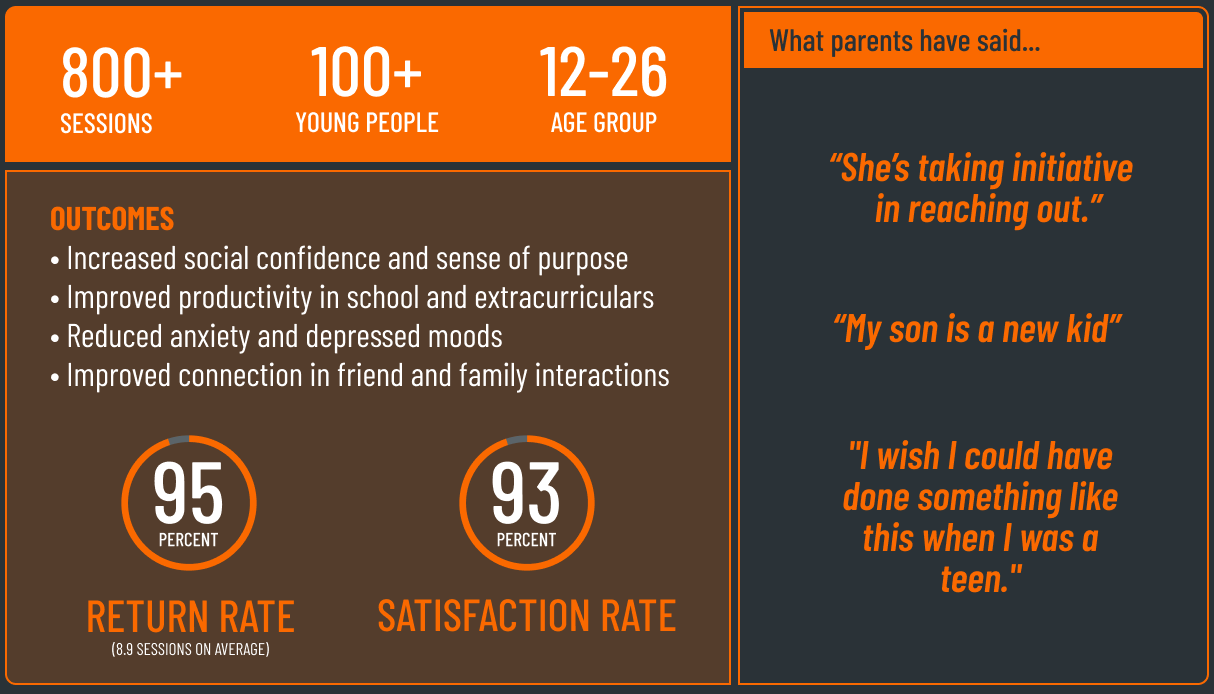
We've seen it happen. One session at a time
Impressive results
TRENDS AND PROJECTIONS FOR THE UP AND COMING GENERATION
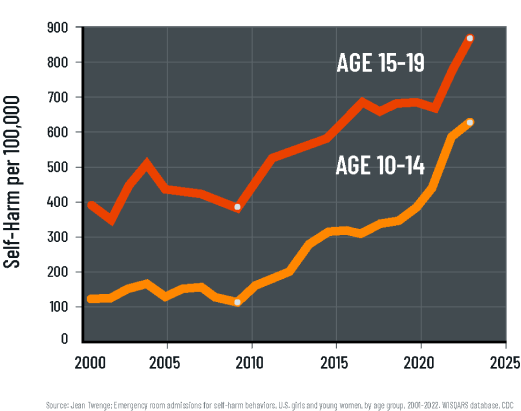
For those who want to understand the full scope of where these trends are heading The current trajectories are troubling. Since 2009, more than twice as many 15- to 19-year-old girls have been admitted to U.S. emergency rooms for self-harm. Even more shocking, five times more 10- to 14-year-old girls were admitted to the ER for self-harm in 2022 than 2009.
The patterns of disconnection can have lifelong implications. As recently as 1980, only 5% of adults never married. Projections now show that distressing numbers of todays 20-year-olds will never marry, including one-third in the U.S. and nearly half in the U.K. This is highly concerning for the well-being of our society.
And there is a looming threat of even more human disconnection for our young people with the emergence of AI companions. Some surveys of young adults indicate that one in three respondents would consider AI as a romantic partner. Since human connection is critical to every major area of well-being, the consequences of real human relationships being replaced by AI are life altering-and in some cases, without intervention, irreversible.
These aren't inevitable outcomes. They're the result of a gap in support — one that connection coaching is designed to fill.
Take the Next SteP
Not Sure Where to Start?
Answer 3 quick questions and we’ll point you in the right direction.
FREE CONSULTATION
Your first conversation with WeYouth is completely free. No commitment. No pressure.
We'll spend about 20 minutes getting to know your situation, answer your questions honestly, and help you figure out if WeYouth is the right fit for your teen. If it's not, we'll tell you that too.
Most families leave that first call with a clear next step — and the relief of knowing they're not alone.